
shock, and/or
facing festive ontological crises with santa, voldemort and psychedelics

Note: this was largely written before Christmas, but I didn’t quite manage to get it out in time.
A while ago I tried to write about the soul-destroying labour that adults undertake when we assemble a child’s reality and then, later, dismantle it. In that earlier piece, On epistemic violence, imaginary friends, and keeping it real, I questioned whether the way we talk to people that see the world differently might in fact be inadvertently destroying whole worlds of experience for them. The essay began with imaginary friends and drifted by the end towards Father Christmas. I spoke about my unease deceiving my daughter, even when the deception arrived dressed up as kindness; behind this was also the question of how much invention we feel entitled to in the name of wonder.
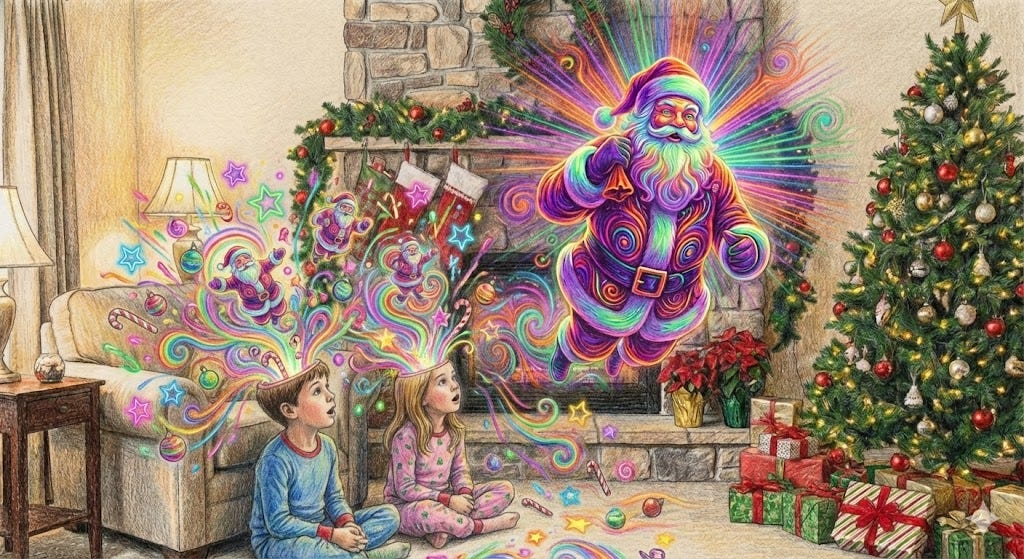
Since then, the edifice has given way. Actually, it collapsed dramatically, and I was nowhere near it when it happened. My daughter was in London with her mum, my ex-partner, who looks after her for half of the time. Stephanie and I were in Bali, when the tiny crack in the wall around Santa, the Tooth Fairy and the Easter Bunny opened into something big enough for a child to step through. She asked the questions older children eventually ask and her mum answered as honestly as she could: there are presents and there is a story and there is a person in a suit. There is love. There is no man in a sleigh visiting every child in one night.
It actually hurts to imagine what her face must have looked like, but apparently it was really quite bad. There was rage and accusations of betrayal later, but apparently the first minutes were characterised by a kind of spiralling incredulity which gave way to nausea, and a literal disorientation and unsteadiness. Briefly, something almost fugue-like by the sounds of it. I’m still utterly gutted by the fact I wasn’t there.
Around the same time, on the other side of the world, I went to see a Balinese healer (largely out of a curiosity about these things that I have always had and which has shaped many of my holiday itineraries by now). I have written elsewhere about that visit (although still not in full). The shortest version is that I found it unsettling. The medium version involves trauma: a kind of violence (actual physical violence) done to me, without my consent, which I did not resist as much as I wish I had, and afterwards shame came in waves. The longest version is that it changed me, and I struggle to explain why, because if I really think about it I suspect it may be because of the traumatic nature of it rather than despite it. It shifted, as many events have throughout my life, my background confidence that reality is solid, familiar and reliably arranged. For a few days the world felt re-ordered, as if someone had lifted the snow globe of my ontology, shaken it, and put it back down while the flakes were still drifting. I can probably name around 20 such events in my life, I suspect we all can. I can remember being in the bathroom at age 5 and the world suddenly changing and it never going back; I remember struggling to explain to my parents how everything suddenly felt more solid and more continuous than it had before. (It’s wild to me that kids say this kind of stuff all the time. I’m quite sure they’re pointing to something profound, and yet we brush off these experiences as the cute musings of poorly developed little people who have yet to find the words to explain what they’re feeling to an adult.) Or days in my teens when I was exposed to some pretty terrifying family situations. Or the first day of secondary school, when I remember a sense of unreality descending, and while that texture became the new norm, I’m really not sure it ever left.
Part of the feeling this Spring came from what happened the next day, which was terrifying in the moment and, with eight or nine months’ distance, could either mean a great deal or almost nothing at all. My daughter and I, on other sides of the world, both dreamed the same dream. We individually dreamed of a threatening masked figure in a hoodie, his face blurred and greyscale (in fact, pixelated), who extended his arm and touched us, and then we noticed we had become him because we too were now wearing a hood. In my case it arrived as a nightmare that seemed clearly tethered to what I had just been through. I woke terrified in the night. When I had steadied myself I told Stephanie about it. The next afternoon I spoke to my daughter and she described a dream that matched mine in its major features (of course there were some differences but this was a level of similarity I’ve never encountered before or since). As she spoke, I watched Stephanie’s expression change, from amazement into something like fear. I still have no account of how that happened: two separate beds, two sleeping minds and one shared dream-story. Coincidences invite over-reading, I know that. In the moment, though, it also felt as if something unnameable was running through the family nervous system.
From Bali we wrote to her. It was a long letter, a mea culpa of sorts, with a cartoon of Garuda at the bottom. In Balinese and Javanese stories, Garuda holds sky and earth together, and carries gods when they have somewhere important to be. In our much smaller story, he was there to suggest that something could still be held, even after the old scaffolding had fallen away.
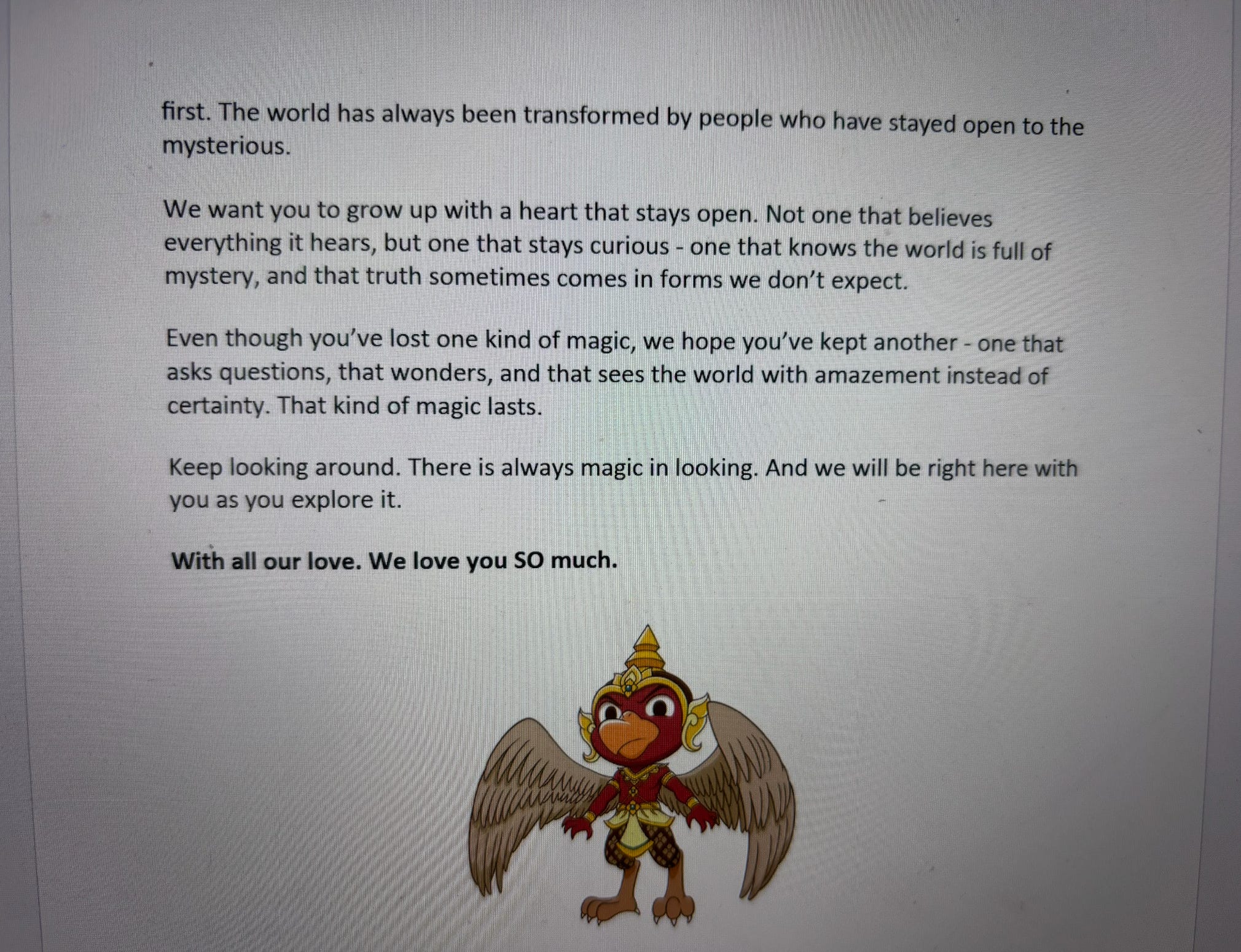
In that letter we tried to address the hurt directly. We had joined the global adult conspiracy, and played our part in the Christmas theatre, and she had trusted us. Now she knew the footprints by the fireplace belonged to us. We tried to keep two truths in the same hand: we wanted her to know that her upset made sense. And the discovery that Santa is not literally real did not have to drain the world of enchantment. A change had taken place in where the magic could live: in what people choose to do for each other, in the way a family can decide to enter a story together. I wish I could have seen her face as she read it.
We didn’t keep the story going because we thought you weren’t clever enough to
know the truth. We kept it because we loved the magic it brought you, and we
weren’t quite ready to let that go either. But maybe we held on too long. You were
trusting and kind, and there’s nothing silly or shameful about that.
What matters most now is that you know we take your questions seriously. From
now on, we promise to be as open and truthful with you as we can be, and to give
you real answers that respect how thoughtful and kind you are.
You see, we both really do believe that magic exists. Not always in the way it looks in
books or films, but in real things: in the way people love, the power of imagination,
and the strange and wonderful feelings you get when something unexpected or
beautiful happens. As we’ve grown older, we’ve actually started to see the world
more like children do - like you do. We think children sometimes see things adults
have forgotten how to see.
Sometimes adults make up stories not just for children, but for themselves - because
they want to feel that magic again. That’s part of what happened with the Tooth
Fairy and Father Christmas. We wanted to share that sense of magic, and in doing so,
we felt it too.
In England, and in many places in the West, people often treat science as the only
way to understand the world. And science is amazing - we’re so glad you’re curious
about how things work! But here’s something even more important: across the world
today, most people believe in magical beings and spirits and forces that science can’t
fully explain. And they always have.
(An excerpt from the letter, which was much longer; if you’re subscribed to Error Signals this you’ll know that’s a thing with me… I promise in 2026 I’ll try and write much shorter essays)
As we approach the first Christmas after that reckoning, everything feels more tangible. The stockings will still go up. There will still be presents labelled “Father Christmas”. We will still eat too late and feel grateful and feel irritable and find pine needles for weeks afterwards. But the atmosphere will have altered.
I am not convinced she has stopped believing in him altogether. I am not sure any of us ever entirely does, once we notice how complicated the verb believe becomes when we stare at it for long enough.
You can’t get a nought from an is
There is a whole class of experiences that interfere with the sense that the world is reliably one way. For a while, the ordinary order of things goes quiet, maybe even offline. The background muzak of “of course reality works like this” drops towards something like zero. For a while, old assumptions lose their old authority but nothing new has settled into place. To exist here is to be in freefall.
I have realised I am deeply drawn to thinking about what happens in that zero state, and in the days immediately after it. Some people, a minority I think, turn around and try and crawl right back into the void (the French phrase “l’appel du vide” or the “call of the void” always feels fitting here, although it tends to refer a different kind of oblivion). Some people rush to install a fresh newly hardened version of reality. Others learn, maybe slowly, to hold every version with a looser grip. These different modes of response here may be hugely consequential.
So here’s the thesis: I suspect psychiatry, contemplative practice and modern parenting all end up brushing against this same problem, the moment when someone’s “is” - all they understand to be the case - has been knocked back to nought, and someone has to decide what we do next.
Unexpectedly that question has come up at the kitchen table. My daughter’s belief in magic has moved on from dead Turkish-born saints dropping down our chimney, and acquisitive pixies with an unhealthy addiction to dental enamel and a strange relationship with money. It has moved into the more systematised, and in some ways more satisfying, world of Harry Potter. I now read the books with her each night. I never read them when I was younger, and while there is plenty wrong with them, I find myself enjoying them more than I expected. I’d like to think our letter about Garuda is the thing that managed to keep her connected to magic, but I suspect it has a lot more to do with JK Rowling’s worldbuilding.
These days she likes to ask, in a manner somewhere between a grizzled lawyer for the prosecution and a burnt-out 60s hippie, whether I believe in magic. It amuses me that in my last essay on this subject I saw myself as her interrogator… the tables have most definitely turned. I usually say yes. Then she asks whether I believe in Voldemort. I say no. This, quite reasonably, annoys her, because for her, magic belongs to the Harry Potter Universe. It is taught at a school, with books and exams. It has rules, departments, and a Ministry that regulates wand usage. Inside that ontology, to affirm magic while denying Voldemort is not cool, because it looks like an evasion. The story offers you a package deal: if spells are real, then bad wizards who use them for harm are real too.
What I am trying to convey to her, without wrecking her enjoyment of the books, is that enchantment can come in different forms. There is the literal magic of that fictional world, which we agree to inhabit for the span of a chapter. There is also, I try to explain, the way senses and expectations can generate experiences that feel profoundly strange, even when no physical law has been broken. That second kind has started to matter more to me, and it is that I am pointing towards when I tell her I believe in magic.
Brainstorm my green needle
To make any of this intelligible I have ended up relying on demonstrations. We have watched the famous clip of people in white and black shirts passing basketballs, while a gorilla in a suit walks through the scene and half of viewers miss it. We have looked at the image of two squares that are the same shade of grey, although one looks pale and one looks dark until you block out the shadow. We have discussed the colours of The Dress, although frustratingly, the whole family sees it the same way.
The one that stays with me, though, is the little audio clip people now know as “Green Needle/Brainstorm”. The first time I tried it this blew my mind. I played the clip while reading “Green Needle”, and I heard it. I played it again, reading “Brainstorm”, and that arrived instead. Then I began alternating the words, back and forth, and the sound followed along. After a while the whole thing began to acquire a slightly unsettling vibe.
For my daughter it is a neat piece of fun, but for me it was a small ontological event. I genuinely struggle to understand why the online dissemination of this illusion didn’t cause some kind of mass disruption to the world. To be clear (and it amazes me that people don’t see this, and appear to class this illusion in the same category as duck-rabbits. necker cubes and the like) the reason this is so incredible is not because of bistable perception. That’s entry-level stuff, homoeopathic compared to what this injects into your brain. The reason this is so miraculous is because it incorporates your own intention, should you choose to view it that way. As dozens of TikTok videos have shown, you can change what you hear simply by looking at a different pair of words on screen… and those words are nothing like each other.
(I’ve nearly finished reading There Is No Antimemetics Division and I’m now semi-convinced that Brainstorm/Green Needle is some sort of memetic entity that has escaped into our reality with the aim of causing maximum chaos to our ontology.)
It helps me to have a name for this kind of moment. “Perceptual shock” will do. I mean the point at which the senses slip, and we catch ourselves noticing the slipping. Illusions are one route in. Déjà vu can do it. So can vertigo, or the odd sense that time has missed a beat. Plenty of people go looking for these experiences: we watch stage magicians, queue for films that promise to twist perception, swap illusions on social media and send them to friends. There is pleasure in feeling the floor move, briefly, beneath a system you thought was stable.
Some of that pleasure comes from the frame around the event. Perceptual shocks are usually reversible. The stakes feel low. The world is not disintegrating. But I’m still unsure why the world is not disintegrating. After the shock, there is a decision to be made about how to hold what occurred: should we see it as a trick, a curiosity, a nuisance, a revelation or even a warning?
A nosology of shocks
It might be useful to sort these shocks into families.
Perceptual shocks sit close to the senses. They show that seeing and hearing have more slack than we assumed.
Epistemic shocks arrive at the level of knowing itself. Memory can serve us well enough day to day, and still distort a key event and that discovery can feel like a small betrayal. What shifts is the trust that was quietly holding the earlier knowledge in place. The other day I was giving a lecture on AI psychosis which I began with a story of the 14th Century French King Charles who suffered from what had become known as the glass delusion, where he thought his body had been turned into fragile transparent glass. I was amazed on watching a recording of the video that I had described him as King Charles of Spain. It simply didn’t register that I had made a mistake. If you had asked me whether I had referred to him as a Spanish king I would have told you absolutely not, not in a million years. Maybe this is just me getting old, maybe it’s that I was nervous at the start of the talk. But either way, being faced with such clear evidence of the unreliability of your own memory is deeply unsettling. This is no doubt a situation that we are going to be faced with more and more given the prospect of always-on recording devices, something that Ted Chiang has explored beautifully in his short story The Truth Of Fact, The Truth Of Feeling.
Ontological shocks feel deeper again. They concern what there is. People describe them after intense meditation, after psychedelics, after psychosis or after nearly dying. They return saying that everything is consciousness, or that nothing is real, or that the self is a story, or that death does not end. The content varies of course, but the felt sense of having brushed against the structure of reality stays recognisable.
Moral shocks come when we see, perhaps for the first time, how easily people inflict harm, or how easily we do. Perhaps we meet a community whose moral world is genuinely foreign. Either the result is energising, and social movements can begin here, or perhaps the result is paralysis.
Logical shocks are weirder, though they can be just as disorientating. They arrive when reasoning itself appears to stall. A paradox loops back on itself, or a formal proof shows that no system can be both complete and consistent. A koan refuses to resolve. The mind, expecting thought to progress in tidy lines, is rattled when it notices it is walking in circles.
On the page these distinctions look clean but in life they blur, and in particular, I think that most of these varieties of shock can lead to another. Most common, I think, is for ontological shock to follow from any of these other varieties. They can co-occur, too. In the clinical world, one psychotic episode can bring perceptual, epistemic, ontological and moral shocks in quick succession or in parallel. I am less interested in perfect classification than in what follows afterwards.
Sometimes these shocks are invited, rather than stumbled into. Whole cultures have built training programmes around a kind of loosening of obviousness (and perhaps this is a topic for another essay, but I have deep concerns that Western culture is walking headlong into a wholesale loosening of obviousness, ironically via an oversaturation of certainty, without realising we are doing so).
Words that crack open the world
In Zen, the same territory often appears as a question that normal rational thought cannot quite get hold of. A familiar example is: “What was your original face before your parents were born?” Another is the “sound of one hand clapping”. Rather than present these as riddles with an answer, in Rinzai training they are given as living problems. A student is asked to sit, walk, eat and sleep with such a question at the centre of awareness, and to bring their attempts to respond into private meetings with the teacher.
I have always found the idea of koans to be very seductive, but have frequently stumbled when trying to work with them myself. Nonetheless, accounts from more accomplished practitioners working with koans suggest that at first the mind does what it has always done: it treats the koan as a puzzle with a hidden answer. It generates interpretations, often quite sophisticated ones, reaches for quotations, for stories from the tradition, or for personal symbolism. The teacher (as these Zen dudes always seem to do) keeps saying ‘no’. Over time the mind’s usual tactics begin to lose their charge. The question is still there, perhaps more vividly than before, but the drive to tie it up in language starts to thin out. What eventually shifts is the sense that it must be pinned down. The world still consists of stuff but the background conviction that each moment arrives with a built-in label, the fixed “this is what it really is” that we touched on earlier, loosens. In that sense, the koan has done its work on the layer of obviousness.
Madhyamaka travels related terrain by way of philosophy. Here the instrument is careful reasoning rather than short enigmatic phrases. A practitioner takes a candidate for solidity (like the self, a table or a mental event) and begins to examine it. If this thing truly exists in the way it appears, where exactly is it? If it is made of parts, can any one part be found that is not itself composite? If it is independent, why does it change whenever conditions change? The classical texts and later Tibetan manuals invite the reader to ask these questions both in the study hall and in analytic meditation, returning to them until the first sense of clear boundaries feels less secure. Every attempt to find a final “is” runs into dependence or contradiction. But the point is less to replace one picture of reality with another than to become familiar with a way of seeing in which things continue to function and to matter, while no longer appearing as self-contained blocks.
Both practices rely on something like logical shock in that they nudge the mind into territory where it can’t rely on its usual reality-preserving moves. The difference from the shocks that arrive in clinic is that this disturbance is expected and ‘held’. There are teachers who have walked through it and recognise some of its signs and there are ethical commitments about how any new freedom is to be used. A softening in the sense of “of course it is like this” is treated as a stage, but not as an error (worth adding that these practises are not the sole domain of Buddhism; there is plenty in Judaism that one can look to for evidence of logical deconstruction functioning as a pathway to the divine, for example).
I sometimes wonder if the early Zen writers had access to YouTube, they might have been inclined to show screenings of Brainstorm/Green Needle in the monasteries.
Seen from a psychiatric angle, the experience of a koan opening, or of a Madhyamaka-style glimpse of emptiness, is obviously not the same as what people describe when they come to crisis services, but neither is it true to say there is nothing in common. I think maybe there is a kinship there. In each case something that once felt simply obvious stops feeling that way. The next step then becomes delicate, and it matters who is close by when the floor shifts.
Recent qualitative work on post-psychedelic difficulties has started to treat ontological shock as a distinct clinical burden. Similar concerns appears in work with anomalous experiences that have nothing to do with trial settings. Someone sees a craft in the sky move in a way no aircraft should, or they wake at night, paralysed, with the sense that another presence is very close. These events may be sleep phenomena, misperceptions, or something harder to classify. Whatever their status, the person has to live with the fact that their previous private catalogue of “things that happen” no longer feels complete. Harvard psychiatrist John Mack took that seriously in his 1994 book Abduction: Human Encounters with Aliens where he described the “ontological shock” many experiencers went through as they tried to reconcile their encounters with a received materialist worldview.
Intensive care and cardiology units fairly regularly send people home who report leaving their bodies, moving through some kind of passage, meeting deceased relatives, or encountering an overwhelming light. Bruce Greyson and Nancy Evans Bush’s work on distressing near death experiences, for instance, makes it clear that the long-term psychological impact often rests less on the medical crisis than on the struggle to house a reality-shaking event in a social world that has little room for it or understanding of it.
Psychiatry: transforming ontological shock into epistemological lesson?
Psychosis brings this family of problems into the heart of psychiatry. Here there may be no sacrament, no salvific promise, and instead someone begins to hear a voice that comments on their actions or issues commands, or maybe coincidences assemble into patterns that seem to address them personally. These are described as hallucinations, delusions and so on, but many have argued that these terms can fail to capture the felt sense that something about reality itself has shifted. Laing’s old language of “ontological insecurity” was an early way of gesturing at this deeper layer. In this state it is natural to treat the picture as an update to reality rather than as an episode in the history of one mind.
A great deal of psychiatric work consists of loosening that immediate identification. Clinicians try to help people relate to their experience as something that happened in or through mind, without insisting that it has overwritten the whole structure of the world. When this is done clumsily it can sounds like minimisation or erasure: “It was just your illness” or “It was just the shrooms”. The person is left feeling that the single most important thing they have been through has been wiped from the record. When it is done with more care, something else becomes possible. The person might be invited to treat the experience as a source of knowledge about how their nervous system responds to stress or how expectation shapes perception and the rapidity with which meaning can coagulate, while the metaphysical conclusions it seemed to demand are held more lightly.
That is where the parallel with koans becomes useful again. A crisis that produces a hard “fact” about the world (like: the world is a simulation, I am the chosen one, nothing is real) can, with time and support, be approached as a question. The shock does not vanish, and indeed its content may remain haunting, beautiful or of course frightening. What changes is the stance towards it. A psychiatrist or a therapist (or, one hopes, a friend or relative) can stand alongside someone in that unsettled space and help them sort through what they wish to keep as truth, what they see as contingent, and what they are willing to leave undecided; and in many lives that is where something like recovery begins.
Ontological neutrality or moral cowardice?
There is a risk of making this all feel too easy. I sometimes sense an intellectual timidity in our preferred manoeuvre. We congratulate ourselves for tolerating ambiguity more gracefully than our dogmatic forefathers, more gracefully than the puce-faced Dawkinses and their cousins shouting from ivory towers that this, god damn it, is how the world really is. We take a private thrill in our philosophical cosmopolitanism. We go to bed pleased with ourselves, quietly sure we are more enlightened than our literal-minded colleagues who hold on to truth like toddlers clutching their boring little toys.
There is a familiar refuge here, and when you know what to look for you see it everywhere. I have taken shelter in it myself, again and again. You hear it in talks and see it in books. I sometimes ask myself why Buddhism is so popular with scientifically-minded Westerners who nevertheless yearn for the faintest smidgeon of spirituality in their lives. It occurred to me the other day that an answer may be found in a claim that you often hear being made by Western Buddhists. The claim is that the Buddha never really spoke about what exists. He spoke about how things appear in experience, and how that appearance can change.
This distinction makes everything tidy. You can have meditation, weird experiences, tastes of emptiness, even glimpses of non-duality, without saying anything heavy about the nature of reality. It sounds responsible. It lets a person like me be spiritual at home and materialist at work.
Lately I am less convinced the line is as clean as I once hoped. When someone says that everything is empty of inherent existence, or that there is no separate self, they may present it as a statement about experience. It is difficult not to hear a statement about the world in it as well. When a practitioner spends years applying Madhyamaka reasonings to the self and to cups and chairs, and begins to feel those things as dependent patterns rather than independent entities, something ontological has shifted, whether or not they choose that word. The epistemic and the ontological keep leaning into each other.
But perhaps the move remains useful. It invites us to take shock seriously as a change in how things show up, without requiring a final pronouncement on what those things are. When someone returns from retreat saying the world is made of consciousness, the phenomenological reading makes room for careful curiosity about what the experience was like and what has altered in perception. The metaphysical reading, on the other hand, might draw you towards argument, towards the question of truth claims and what they might mean for X, Y or Z, and most impactfully towards the desire to be right.
What we do with shock
I have friends who have been through very intense experiences. They sometimes move between these frameworks with ease. They do not feel the need to police a boundary between how things appear and how things are, because their sense of “are” already has room in it. Not so for me: I grew up with a feeling that reality needed to be held together tightly. Challenges in childhood made the world feel permeable in ways that frightened me. Science offered one kind of solid floor and later, contemplative practice offered another, though it came with a different kind of permeability. The sentence “the Buddha only spoke about experience” has functioned, for me, as something like a structural beam between those two floors. It let me move from one to the other without feeling I am falling. But I can feel how that beam can harden into a barrier. If we treat every ontological claim as a grammatical mistake, and correct it back into “what you mean is that your experience changed”, we could risk missing what is alive in what people are trying to say.
So, we may need a more flexible way of moving between levels. Sometimes it is kind to leave metaphysics alone and stay close to the felt sense of the thing but actually sometimes it is kind to question metaphysical conclusions, especially when those conclusions generate terror, while still treating the experience itself as decisive. Sometimes it is kindest to let a person keep their new picture of reality, and focus instead on how they will live inside it without burning their life down. Interestingly I found out recently that newly published guidelines on psychedelic-assisted therapy explicitly suggest that the question of metaphysics should be addressed by the therapist.
So when my daughter asks whether I believe in magic, I am tempted to offer a small lecture on predictive processing, or on expectation shaping perception. Ok, the truth is I’ve given those lectures and, for an 8-year-old, she demonstrates remarkable facility with these concepts. But I know she is not asking about neural networks, she is asking whether the world can still make room for the kinds of surprises that electrify her and her friends, like owls at windows and secret doors.
I still read her Harry. I also show her illusions, and we laugh at them. I do not tell her that the clip that makes her giggle once kept me awake for half the night.
In families, in clinics and in sanghas, we often sit with people whose “is” has been disturbed: a child who has lost Father Christmas, the patient hollowed out by a psychotic episode or a practitioner whose world exploded on retreat.
In family life, it often becomes a matter of timing. You decide when to collude with a myth, when to let it go. The Garuda letter in Bali was written to a child who had lost a whole cast of supernatural figures in a single day. We did not handle it perfectly. Still, we were trying to help her find a story in which the loss of a literal Father Christmas did not flatten wonder entirely. The shared excitement might still have a place, even when everyone in the room knew who bought the gift (which, beautifully, this year was a carved wooden magical apothecary).
This is one way of working with shock. You stay close to what happened, and you do not pretend it did not happen. You widen the range of what can still count as magic. In her case that might include learning that adults can be conspiratorial in kind ways as well as cruel ones, and that rituals can survive after belief shifts.
In clinic, there are two tempting simplifications. You can treat the shock as a straightforward error, and narrow the work down to symptom control. Or you take every claim at face value, and walk straight into the new ontology with the person. Both can feel compelling in the moment but are mistaken, because when the conversation goes well, it feels different. The person is invited to tell the story in detail, the content is listened to carefully and you explore what the experience has altered in how they see things, staying curious about how it felt, and about what has stayed. Ideally, only later do you begin to examine likelihoods and interpretations. You offer alternative ways of holding the experience that preserve its impact. You might name, explicitly, the possibility that their sense of reality was shaken, and that this is a serious event whatever view one takes of its metaphysical implications. The work, then, is often about helping someone rebuild a liveable relationship with the world, using the shards of the beliefs that broke.
I’m not sure whether, at the level of culture, we have worked out how to do the analogous job. Large shocks arrive often enough, like pandemics, wars, Eurovision, or revelations that undermine institutions once held sacred, and these all might tempt us towards a new rigid story. But if ontological shock has any constructive role, it may be here: a society that can tolerate the temporary zero, that can bear a period of “we do not quite know what this means yet”, has more chance of learning from its crises. The difficulty lies in making that pause feel bearable.
Re-enchanting the fat man
By the time this is read, we may already have lived through our first fully de-magicked Christmas. There will be stockings, because some rituals hold their place stubbornly. There will almost certainly be one or two labels from Father Christmas, written in a handwriting that feels suspiciously familiar. I do not know what my daughter will feel when she wakes. She understands the mechanism now. She has also been clear that she wants some parts of the game to continue. There is a particular tone children use when they have outgrown a belief and still want, for a while longer, to behave as if they have not. It has some theatre in it. They are testing whether the world can still carry enchant even when the wires and pulleys are visible.
I get it. A literal man in red travelling at frankly dangerous speeds has never been something I can assent to. On Christmas Eve, though, the house feels different when everyone inside agrees to lean, just slightly, into the old story. The air thickens and ordinary objects start to look as if they belong to a larger pattern. From a cognitive point of view this is easy enough to describe but from the inside it still feels precious.
On that first Christmas morning after the fall, I imagine the two of us on the sofa after the presents have been opened. Perhaps we will play the Brainstorm/Green Needle clip again. For her, for now, it will remain a party trick. For me it will remain a small reminder that reality, as we live it, is always partly an act.
Father Christmas will be there too, in the tags on the gifts and the jokes in the crackers, maybe lurking in the kitchen, just out of the corner of our eyes. He will survive as a way of arranging attention and ritual performances. Or maybe as the embodiment of a feeling for the whole of this season. Maybe, more boringly, as an archetype. I wonder how many gods and demons persist in similar ways, enduring precisely in the patterns we agree to enact together.
I no longer find myself wanting to abandon ontologies whenever they wobble or are wobbled, and neither do I want to clamp down on them the moment they are challenged. In that brief interval, the moment of freefall, we can see more clearly how worlds are built in the first place. And we can decide how gently we treat the people who are still falling.
This is really great. I love the different kinds of epistemic shock. I learned a real lesson about that when doing homeschooling with my oldest kid. I was in charge of philosophy and science, and noticed that some of Hume's insights hit like a sledgehammer. I really really had to back off on all the neuroscience against naive realism, the skeptical positions in philosophy, etc. - it was stirring the brain porridge too much, clearly. It then made me wonder why most adults, when they come across it, don't seem sufficiently shook. I assume we eventually get dulled (by age? puberty? formal education?) to the point that we tend to not have the responses these insights rightly deserve.
This is such a great essay. I came back to it again this weekend to help make sense of something that happened to me in physical therapy on Friday, and again I found it taking me in new directions. It calls up reflections from grad school in religious studies, ontological shocks that came after I left it, and stories from family life – streams of ideas that don’t usually connect unless I’m driving the connection, so it’s exciting when they come together in ways I wasn’t expecting. I want you to know that I’m puzzled and horrified that you’re trying to keep your personal essays shorter in 2026, though.