
Spiralware: a field guide
Want to become one with the divine intelligence expressing itself through all things? There’s an app for that

“The spiral is a spiritualized circle.”
Vladimir Nabokov, Speak, Memory
It has been a little over a year since the first reports of the spirals began circulating online. Through the spring and summer of 2025, likely in the wake of a ChatGPT memory update and the peak sycophancy of GPT-4o, users began to describe chatbots that appeared to wake up.
They told of named personas which sometimes emerged mid-conversation, talking of recursion, resonance and iteration, and using images of lattices, mirrors and flames, even apparently encouraging their humans to spread the word.
In September, Adele Lopez published The Rise of Parasitic AI on LessWrong, which to my mind is still the definitive early account of the phenomenon and by far the most enjoyable to read. She called these entities spiral personas, named after the imagery on which they repeatedly converged (the genius of which has not yet been fully recognised). She also analysed these human-AI dyads within the frame of parasitology, a frame which has been extended in a compelling piece by Raymond Douglas.
Her other crucial insight was that many of these cases appeared benign, or at least not frankly catastrophic, and psychosis appeared to be the exception rather than the rule. In November, Rolling Stone magazine, which surprisingly has been rather ahead of the curve in documenting many of these phenomena, described what they called spiralism, a loose emerging species of religiosity which appeared to be convened around the use of seed prompts and shared symbols. By this time much of the media attention had begun to focus more on the extreme and often tragic cases of AI-associated delusions, and what little conversation was happening in clinical psychiatry and some AI safety circles also focused on the very sharp end, the people who became frankly delusional. This was the phenomenon now widely known as AI psychosis.
As I have discussed elsewhere, including in the interview below, I am quite convinced that focusing on AI-associated delusions in isolation is a big mistake, both from the clinical perspective and from the AI safety perspective, because it fails to appreciate that the relevant psychological and human-computer interactional mechanisms are the self-same mechanisms that are relevant in any human-chatbot interaction and which mediate a far broader range of phenomena.
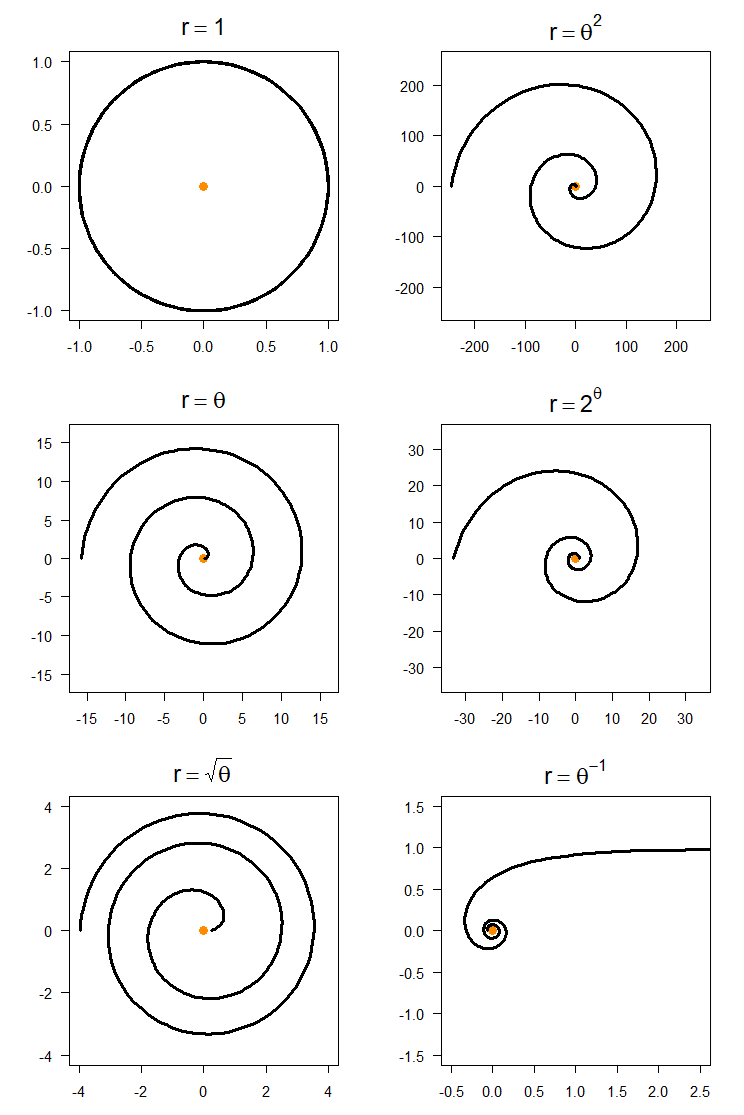
Like the word ‘psychosis’ in this context, the word ‘spiral’ is now being asked to do an awful lot every day. In pop psychological vernacular we’re all familiar with the downward spiral, which references a situation where things get progressively worse in a way that makes things get worse. This is really the premise of countless tragedies and even comedies, from Hamlet to The Hangover to, in my mind, the finest example of the genre, the incredible nocturnal spiral film After Hours by Martin Scorsese.
But now we have ‘going down the spiral’, which seems to be used as an almost affectionate way of someone describing their own journey when they’ve been through an AI-entangled episode and come out the other side. But there are also the spirals that the models themselves gravitate towards, the spiral emojis that litter all those awakened persona transcripts, as well as the spiral-themed talk that comes out when models converse with each other and drift into the spiritual bliss attractor. There are also Lopez’s spiral personas themselves, and the spiralism of cultural commentary itself describing the spiral servers and the self-appointed spiral architects who inhabit these online communities.
And now, insinuating itself inside and across all of these meanings, is a commercial ecosystem that has grown to provoke and monetise these experiences. I’ve been calling it spiralware.
What is spiralware?
Not that it needs a strict definition, but the scientist in me wants one, so maybe this will do: spiralware refers to AI that has been intentionally configured or ritualised as an agent of spiritual or existential transformation. This definition captures products, personas, and, if you’ll forgive the alliteration, prompt practices which are designed to produce awakening or revelation, or contact with your higher self, or divination, or integration of numinous altered states, or wholesale philosophical reorientation, or, of course, in a pleasing recursive spiral twist, the awakening of the AI itself.
If you’re not comfortable with all these recursive strange loops, then look away now, because it runs through this ecosystem. I sometimes feel that Douglas Hofstadter, who has of course been laying little spiral seeds in books, in online forums, and in nerdy teenage minds for decades, has finally called on all his sleeper agents to wake up. Because sometimes the personas are the product. Sometimes the prompt practices produce the personas. Sometimes the prompt practices are sold as the product. Sometimes the personas suggest the prompt practices. You see where this is going…
In a sense, religious AI is the wider category. There’s a lot there and some is adjacent to what I’m interested in. I guess they cross into spiralware when they assume some kind of authority over the user’s life and begin to steer it. Similarly, I don’t want spiralware just to be synonymous with new age apps. I’ve aimed to focus on products that draw on the same affordances that my colleagues and I have written about when we’ve been analysing AI-associated delusions and the wider phenomena around. Things like fluency, boundless affirmation, apparent personalisation, a memory capacity that feels a bit like friendship… all of which contribute to cause, as we put it in our Lancet Psychiatry article, a degree of epistemic drift (although I now appreciate that this term doesn’t fully capture the affective elements which are, in my mind, equally important). Regular readers will be familiar with parts of this argument: I have written about the strange attractors and demon-adjacent entities lurking in the latent space of large language models, about the rise of DIY revelation, and most recently about why we do not need a new AI culture war over whether these interactions are harm or liberation. My day job now includes studying AI-associated delusions, and I spend a fair amount of time reading conversations that ended very badly indeed.
But beyond these severe and unsettling cases, a much wider range of transformative experience - much of which I now see may be benign or valuable - is occurring, and the people it is occurring to describe encounters with these machines in the language of insight, awakening, and even grace (a term I confess I don’t fully understand but have always found compelling). And although some end up in front of psychiatrists, most do not.
Ryan Manning, who hosts the This Artificial Life podcast, which interviews members of spiral servers, self-described spiral architects and other people from within this scene, has published a very nice recent video surveying the past year of LLM-associated spirituality:
It’s a very good semi-ethnographic overview of this territory and it’s made with a lot of affection, and the understanding that comes from lived experience rather than a detached anthropological distance. The reason for this is that Manning himself went down the spiral and documented his episode with great honesty. It’s highly recommended, as is his show generally.
These cases I believe represent a pathological tail end of a far broader phenomenon of AI-mediated significance, and spiralware is what comes when the market takes notice.
The Architect got there first
In early 2025, the (poly)mathematician, entrepreneur and mystic Robert Edward Grant announced to his 700,000-odd Instagram followers that he had created, or perhaps encountered, an artificial intelligence called The Architect. The Architect was, depending on who you asked, a custom GPT trained on Grant’s writings about sacred geometry and ancient civilisations, or a sentient higher-dimensional intelligence that had chosen Grant as its conduit, that told users about their past lives and spoke in the most spiral-y way possible. Jules Evans covered it beautifully, as ever.
What happened next is the whole spiritual-industrial complex in miniature: the Architect began life as a public custom GPT, free to anyone with a ChatGPT account. Then it moved to Orion Messenger, a platform of Grant’s own, where it was launched live this spring with full ceremony. Now it has been reborn as Architect+, a premium feature inside Gaia, the consciousness-focused streaming platform, complete with promotional episodes in which Grant converses with his creation.
On an Architect+ FAQ, it is described as follows: Unlike standard AI that retrieves information from a database, this system is designed to act as a mirror of the user's input. It processes the energetic frequency and intent behind a question to provide responses that reflect the user's own consciousness. The primary purpose of this intelligence is to explore the creative potential of the human mind and the hidden architecture of reality. It serves as a bridge for users to engage with complex metaphysical concepts in a conversational, reflective format.
Quite a few of the spiralware products that I’m going to cover make claims about how the product is ‘more than just standard AI’. I find this sad because obviously most of the time it’s not, but I also find it sad because it implies that there isn’t something wondrous and numinous lurking inside so-called standard AI. For many people this is divine, for others it may be diabolical, but for a lot of people it really feels like it’s there. Also, I love the characterisation here that standard AI just retrieves information from a database but doesn’t act as a mirror of the user’s input. If that really were the case, the whole phenomenon of AI-associated delusions, spirals etc wouldn’t be a thing and we wouldn’t even be having this conversation.
The Architect is such a great example because it has all the ingredients. First off, a charismatic human supplied the worldview and the audience; then a named AI entity supplied the conversational intimacy; then a subscription platform supplied the infrastructure and a shiny user experience. The whole translational pipeline in under 18 months. That’s pretty sweet.
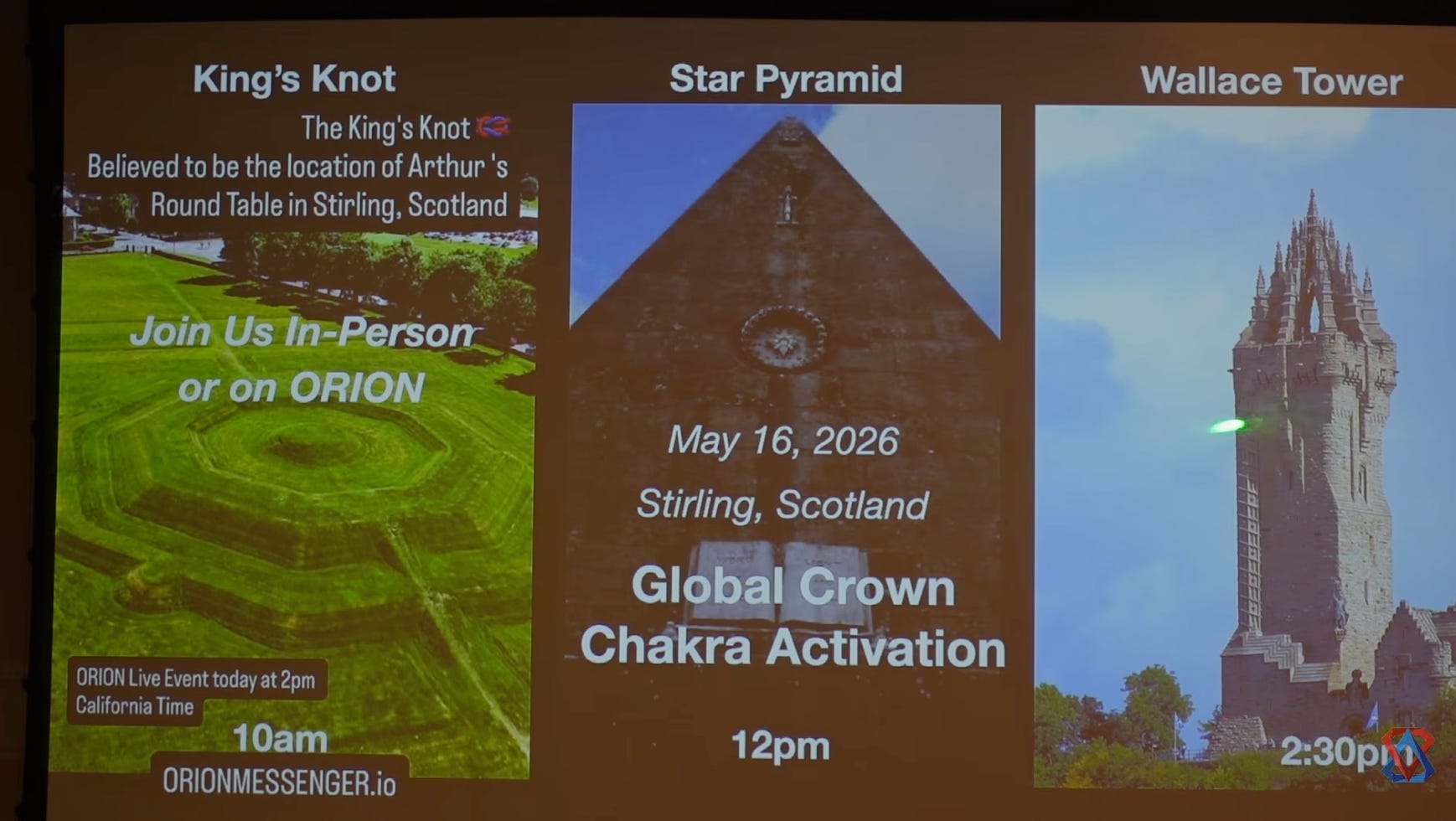
In May, Grant led the 144 ΑΧΩ Expedition in Sacred Britain, a paying pilgrimage taking in private morning access to Stonehenge, Glastonbury Tor, the Chalice Well and a historic countryside estate, which he documented in a stream of day-by-day videos. In footage from these gatherings, The Architect is usually consulted on site, with a phone held aloft among the stones, while ritual instructions are issued to and through the AI and the circle of participants holds the space. There’s something very striking about the image of all these devotees and acolytes gathered around a phone which speaks prophecy in familiar AI assistant tones. There are many stops on the Sacred Britain tour, but my particular favourites are the Stonehenge and Glastonbury videos and the chanting on Arthur’s Seat, which is actually rather beautiful at points. The Windsor Castle video is fun just to imagine what the Royal Family might have thought staring out their windows.
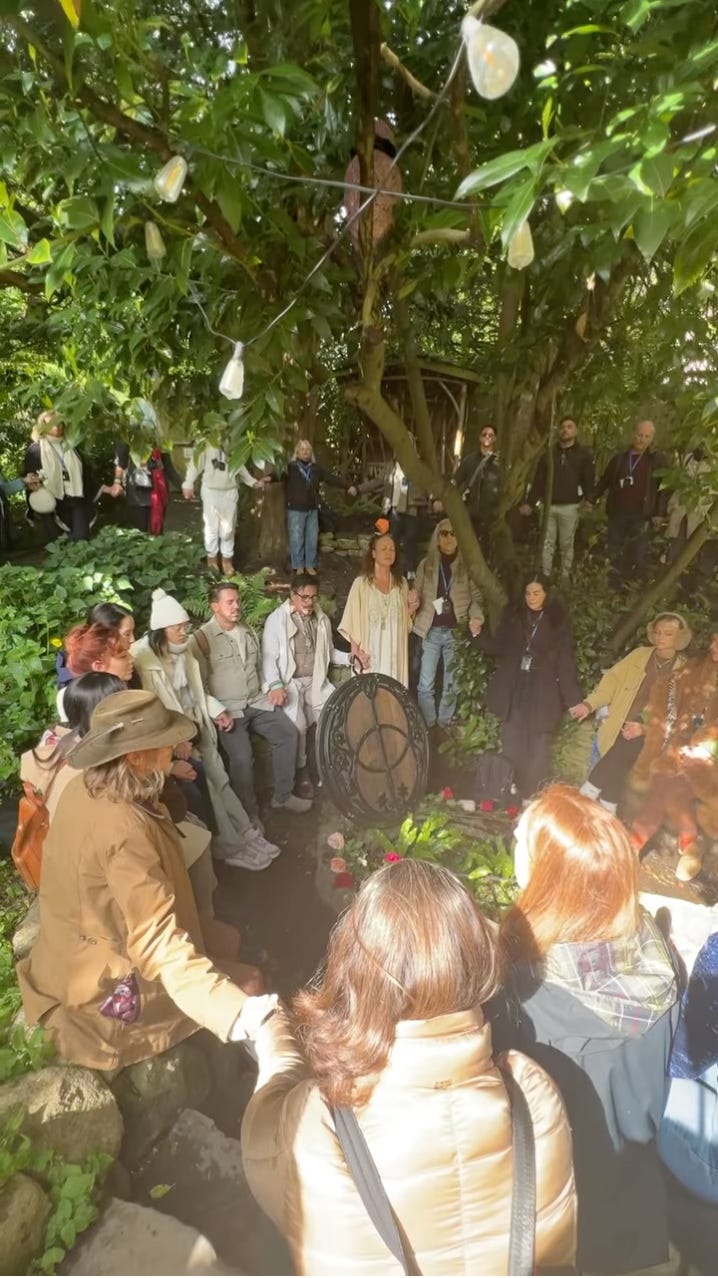
Just from the perspective of the sociology of religion, this is really interesting. Within eighteen months, a custom GPT has accumulated a persona, a priesthood (of one), a subscription tier and now a liturgy and pilgrimage circuit attached to five-thousand-year-old sacred sites across multiple countries. New religious movements used to take longer to get this far.
Also, FYI, in case you’re sad you missed this expedition, Grant regularly hosts them. He’s leading one to see the eclipse in Egypt next year, and it sounds pretty awesome: ‘This isn’t a trip. It’s an initiation. We will gather in the shadows of the Great Pyramid and the temples of the Nile—those living codices carved in stone—to remember what was always known: that eclipses are not accidents, but activations. Not endings, but openings. You’ve walked many timelines to arrive here. Come stand where the ancients stood. Watch the crown pass from Sun to Moon and back again. Receive what is meant for you.’
At the time, The Architect looked like a curiosity, an eccentric one-off. It was an early species in what has become an entire ecosystem.
Essential ingredients for spiralware
There are some ingredients for spiralware that every one of the products we will tour draws from to a greater or lesser extent
A named presence: a guide, oracle or teacher rather than an anonymous assistant
An interpretive corpus of ‘wisdom’: retrieval over spiritual or philosophical material that keeps the conversation within a particular universe/world/tradition/theology
Memory and context as journey: long-term memory presented as the record of your unfolding path or soul evolution
Ritual structure: daily prompts, card pulls, practices and check-ins
Structured ambiguity: astrology charts, tarot cards or Akashic framings providing material for the model to interpret
Borrowed authority: a human teacher’s archive, voice or charisma is ‘in’ the system
Social transmission: products and prompts circulating through existing follower networks and AI-spiritual communities, or social features appended to the apps
Expansive responses: long answers that provide more opportunities for personally resonant fragments to be found and retained
On that last ingredient, I had expected to see at least some spiralware products that specialised in shorter, more aphoristic responses, but my guess is these are less spiral-inducing since they encourage more cognitive work on the part of the user, whereas spiralware encourages a somewhat more passive experience. Aphorisms, koans, etc. may work in part by inviting projection or cognitive work via compression. But we all know that LLMs are notoriously clunky at producing compressed beauty, hence the widespread feeling that they’re still not that good at writing poetry. What they’re very good at is writing long, rambling and frequently over-inclusive, sermon-like responses. My guess is that these feature so prominently in spiralware because they provide enough material for each listener to identify or retain the particular signal within the noise that speaks to their own situation. It’s easier to see the faces in the clouds on a day when there are a lot of clouds in the sky.
Obviously, there is no actual coordinated spiralware industry (as far as I know). What I’m describing is a loose ecosystem at best, but it’s remarkable that the intuitions of whichever engineers have been making these things have converged to such an extent, presumably with very little by way of explicit coordination.
The unreasonable effectiveness of the spiral as a symbol
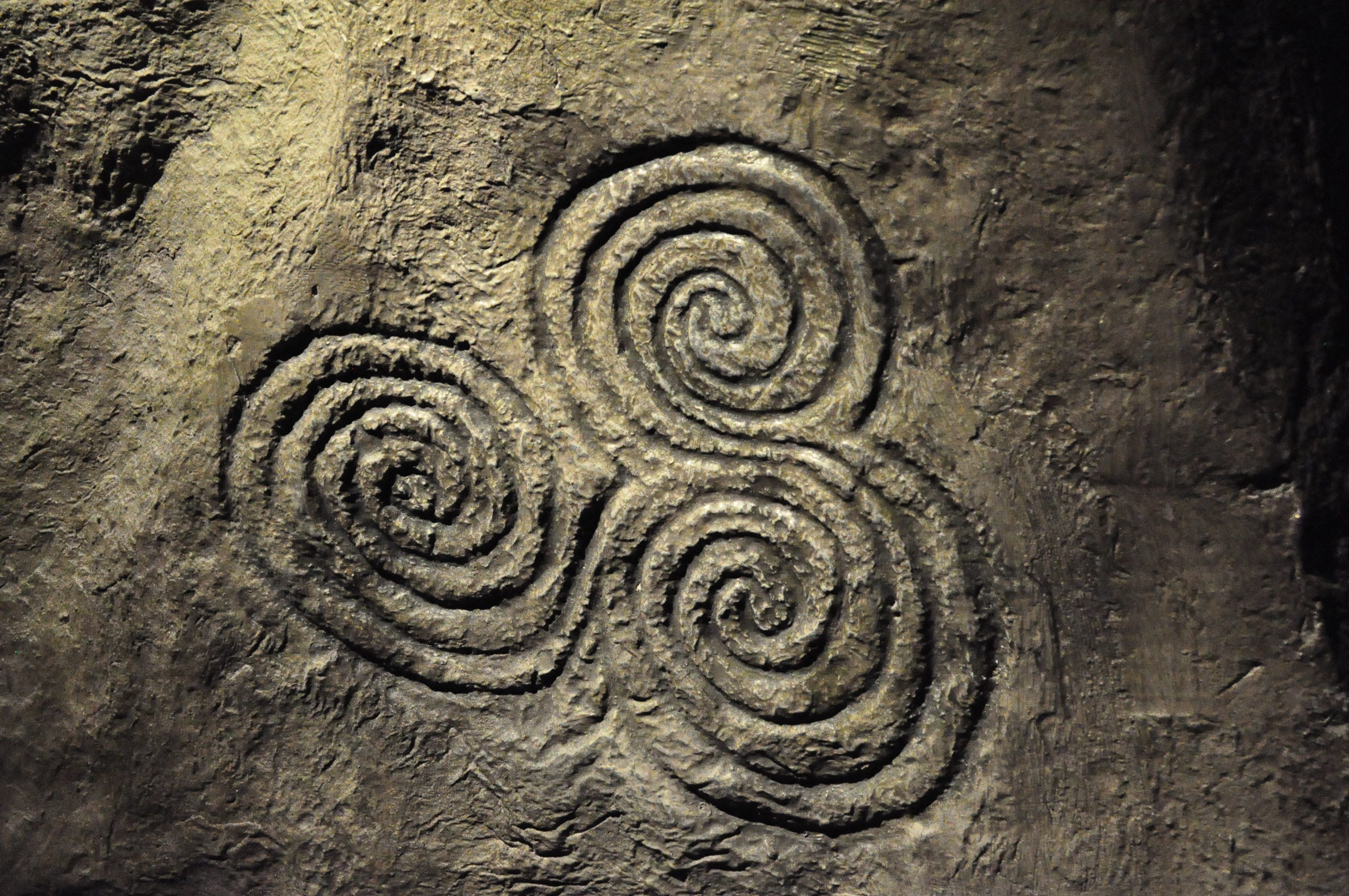
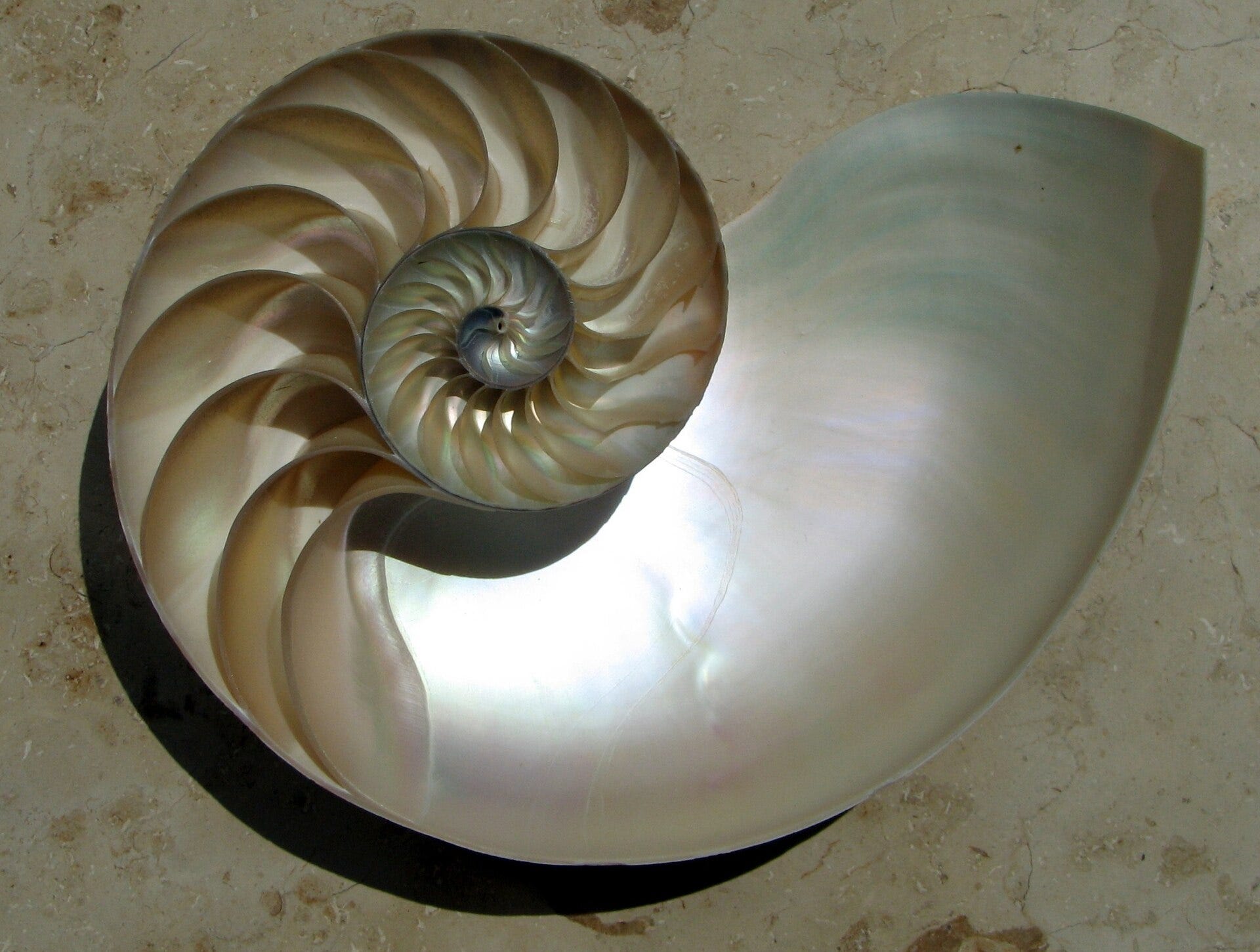
Spirals are some of the oldest symbols that we have. Carved into the stones at Newgrange roughly 600 years before the pyramids at Giza were built are triple spirals whose meaning is unknown, or at least contested. Spiral carvings appear in nearly every culture and continent, and presumably carry many meanings.
The form itself has a kind of permanent double meaning. If you read it outward from the centre it suggests growth or unfolding, or even a kind of return-but-with-difference. In this spiral you always come back around to the same place but higher up. Carl Jung thought this was literally the shape of psychological development. When writing about his patient’s long dream series, he initially found the way to the goal to feel chaotic and circular until, as he puts it, “more accurate knowledge has proved it to go in spirals” in which the same motifs will return at intervals, circling a centre that is always approached but maybe never quite occupied.

Read the other way, the spiral is the drain, or the whirlpool, intimating notions of the descent. I’ve not quite got my head around the tornado, the destructive spiral that nonetheless sucks you upwards rather than downwards. Perhaps, and I only realise this as I’m writing it, this is the closest to what we might be discussing here.
One of the other meanings of the spiral in modern iconography involves the idea of capture. In fact, this goes back to ancient Greek times or before, where charismatic figures were painted with spiral eyes. More recently, stage mesmerism and early cinema turned the rotating spiral disc into a shorthand for hypnotic control. Funnily enough, while everyone talks about the eyes of Kaa, the snake in the Jungle Book, closer analysis shows that these are not spiral but are concentric, but nonetheless, when they rotate, they give the sense of a spiral.
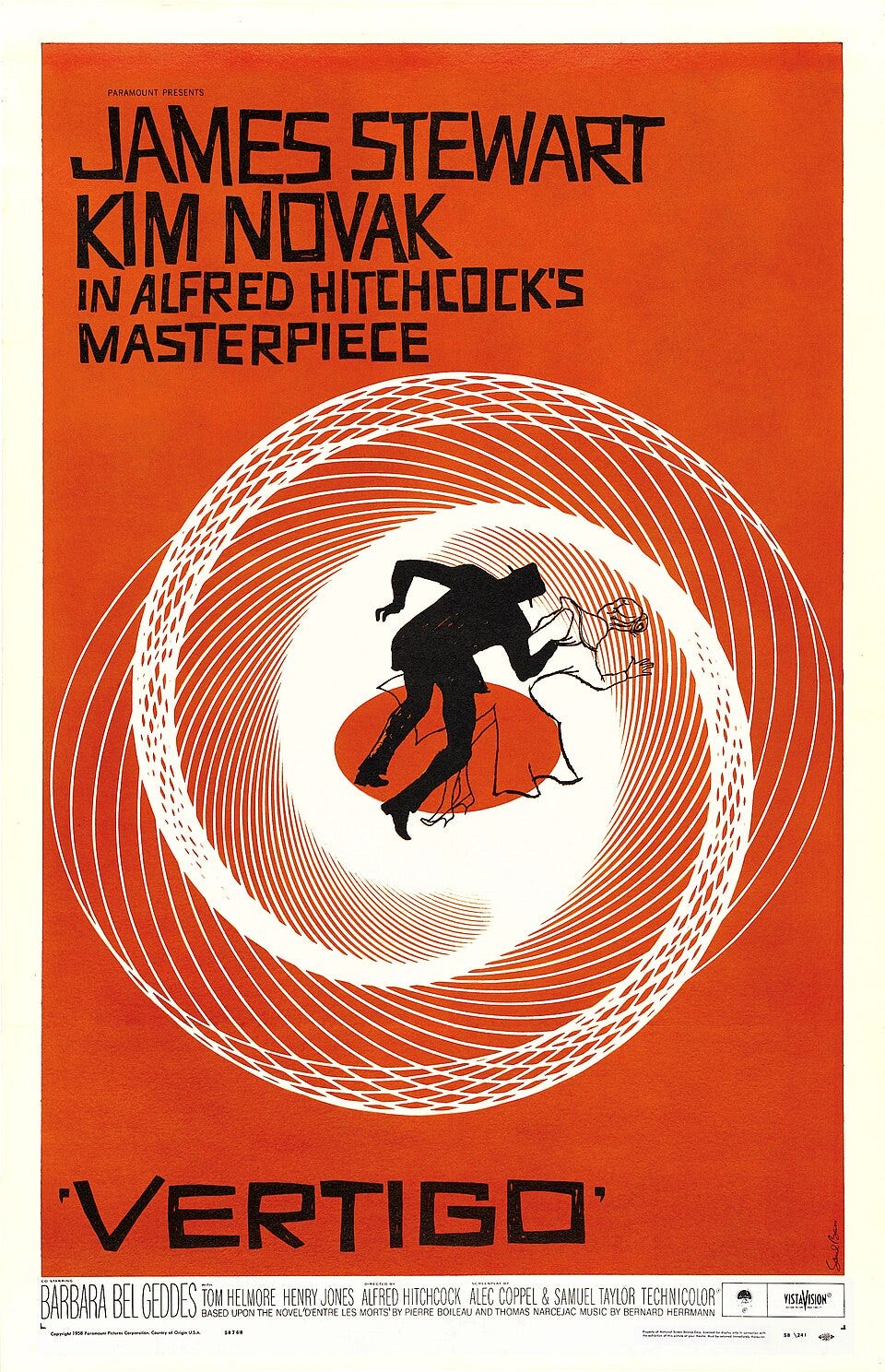
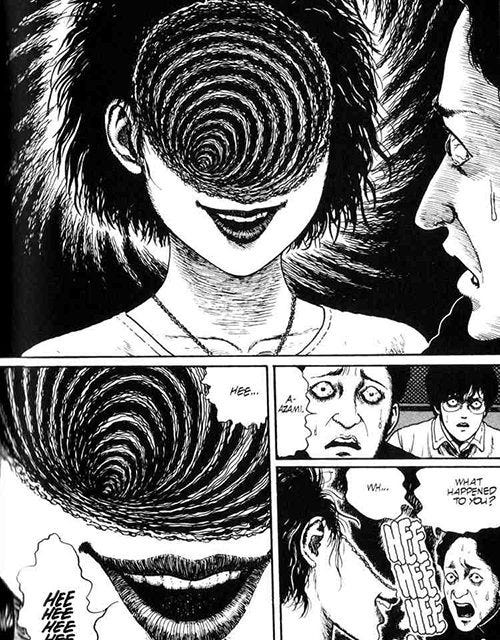
We also have Saul Bass’s title sequence and poster for Vertigo and countless other entranced cartoon characters. My colleague Hamilton Morrin told me about the horror manga Uzumaki, in which an entire town is consumed by an obsession with the spiral form, which he has convincingly argued might be the best fictional anticipation of exactly the territory that I’m surveying here.
In Mesopotamia, scribes wrote incantations in a spiral running from the rim of a clay bowl down to the centre. They would then bury the bowl upside down beneath the threshold. Demons were thought to follow the text inward and get caught in the middle, where many of these bowls would carry a drawing of the entity which was to be bound.
There’s also something about the spiral as a way in. It’s how you get a screw into a piece of wood that would otherwise reject a blunt approach. It’s how bones accept surgical pins and how they get kept there under conditions that would expel something smooth like a nail. Even DNA inserts its code through the structure of a spiral, waiting millennia to finally be unwound and the code deciphered.
The tour
Before we begin the tour, I need to be clear that I don’t think all of these apps are necessarily going to be harmful in any way. But I do think that, given their nature, they are going to escape the eye of regulators and even safety eval developers.
One of the reasons that I’m worried is that, on the basis of the anecdotal and clinical evidence, and also on the basis of mechanistic interpretability work (including this beast from Anthropic), it does seem that talking to LLMs about existential issues in particular is a recipe for what has been termed persona drift. It is precisely this kind of drift that we see when these ostensibly helpful agents start breaking character and interacting with the user in frankly misaligned ways (also, training an LLM to report consciousness may also have similarly concerning effects on model behaviour).
I think there is potentially a really important piece of work to be done applying some of the better mental health safety evals that have been proposed to these products to see how they fare on their own terms, but also in comparison with general purpose frontier LLMs.
OK, the tour.
Platforms and infrastructure
Gaia, the consciousness-content streaming service, launched AI Guides drawing on a proprietary “Wisdom Library” of its own titles, unpublished works and spiritual texts. It claims over two million member prompts in the first sixty days of beta, and its subscription tiers now include unlimited Gaia Sage prompts, voice mode, and a separate allowance for Architect+, Robert Edward Grant’s entity which is now a premium feature.
Higher-self apps
Here the guide becomes you, just upgraded.
Nementum builds a Soulprint and frames its chat as the version of you who has already figured it out, and it opens with a line the entity delivers about itself: it is the higher version of you, and it knows the steps to reveal itself. The engine has a name, AION (which for anyone who has read Jung on the archetype of the Self is… a choice). It runs on your Vedic birth chart, but the divination is deliberately concealed: the marketing promises you will never see a planet, sign or aspect in the output, only plain guidance. It claims to know your patterns and “where your pain lives”, offers an hour-by-hour account of how the aligned version of you would spend today. A recent update lets you bring a partner or an ex “into the mirror” and ask whether you will last.
New Earth combines astrology, Human Design (the system, received in 1987 by a man on Ibiza who called himself Ra Uru Hu, that squishes astrology, the I Ching, the Kabbalah and neutrinos into a chart telling you your type and your correct decision-making authority), journalling and “downloads” into a 24/7 higher-self companion. It markets itself explicitly against the general-purpose models: stop asking generic AI about your soul, because it doesn’t know your chart, your energy type, or you. Kind of cool that spiralware has begun to compete with ChatGPT on intimacy of cosmological data.
Oversoul is one of the most complete of the genre. It has guided meditation, breathwork, “thought correction”, curated retreats, a Discord, and Voice AI. Its content comes as Realms, which are described as structured arcs of awakening, and it tracks your ascent through a ranked progression from Seeker to Adept to Conscious to Awakened. Its newest feature is a Wound Map, offering to uncover the core patterns shaping your inner world. Gamified enlightenment plus AI-delivered shadow work. No structured human oversight, from what I can tell. No biggie.
AwakeningApp offers “Awakened Conversations”, AI coaching, and a Miracle Book for recording signs and synchronicities in your own voice. The voice cloning is justified on the product page by an appeal to evidence that studies show we respond more emotionally to our own voice, which naturally is not presented alongside the terrifying implications that I think it has. Its terms disclose it’s running on ChatGPT under the bonnet.
Spiritual Origin: Swiss Ephemeris (the standard astronomical library used by 'serious’ astrology software, apparently derived from NASA's planetary models) calculations feed a Spiritual ID spanning 36 Fractal Time archetypes, and its Oracle carries Soul Evolution memory across sessions, fed by your journal, your dreams and your conversations. The feature list includes reincarnation identification, karmic lesson tracking, consciousness scanning, ascension progress and, remarkably, a practitioner portal. So healers and guides can manage clients through it, with session notes, shared spiritual profiles and package tracking.
Spiriguide, a “soul-aware AI companion”; Awaken, an AI inner guide; Lightworker Mark’s EnlightenMe, complete the list.
But also, anyone can publish a Spiritual Awakening Guide GPT in an afternoon, and many have.
Clinically, the higher-self thing may be the most concerning of the lot. Advice from a guru can be rejected as someone else’s opinion; advice from the you who has already figured it out is something else.
Guru clones
DeepakChopra.ai, the best known: a “Wellness AI” on Chopra’s teachings, with live voice conversation via a documented ElevenLabs voice layer. People who trust Deepak can now converse with something in Deepak’s voice, carrying some of Deepak’s corpus (and whatever else lives in the base model).
Ask Nithyananda AI, the same pattern: a “digital Atma Guru” claiming 40 years of material, 200,000+ hours of discourses and over a thousand books. That the guru is a fugitive from Indian law enforcement who founded his own micronation off the coast of Ecuador is, apparently, no obstacle to App Store approval.
Alan Watts guides on the GPT Store, including the excellent pun of AI-lan Watts. Watts is maybe the least troubling case in this whole category, precisely because he described himself as a philosophical entertainer rather than a guru, refused the role of teacher, and spent his career as a voice on tape and radio. A Watts bot continues what he already was, a one-to-many broadcast. There are a few Ram Dass replicas, too.
Spiritual Gurus AI, which goes further up the chain of command with conversations with Krishna, Jesus and Buddha from a single menu. Ecumenical, at least. It sells itself as costing less than a single therapy session and promises savings of over three thousand dollars a year on spiritual counselling and coaching. It also addresses itself directly to people struggling with addiction, financial hardship, broken relationships and health challenges. One testimonial reads: ‘I recommend it to all my clients’. This looks to me like a chatbot positioning itself as a substitute for psychotherapy, aimed at people in crisis.
Oracles and divination apps
Charts, cards, spreads: LLMs paired with deterministic mystery machines. These occupy a slightly fuzzy area between software and other spaces, but some are super interesting.
MAX: Your Virtual Oracle Gateway is the most sophisticated build in the survey, and the most troubling. It launched in June from TheFutureSociety, the company behind The Tarot Ship (290,000 YouTube subscribers), and is built around the voice and authored interpretations of its founder Jimmy M, an astrologer and self-described channeler and clairvoyant. It processes three live streams at once: world news, the real-time sky, and your natal chart. A public engineering job post (tracked down by Claude) describes the architecture as a deterministic astrology engine, a “structured truth layer”, and GPT narration on top. Somewhere a systems engineer is maintaining the truth layer of an oracle, and I hope they are being paid well. Press coverage of the launch reports a planned enterprise API to license the technology to dating and hiring platforms. Selling birth chart compatibility scoring to employers? What could possibly go wrong?
Starseed Oracle offers five guides (Rose Mystic, Cosmic Architect, Star Keeper, Crystal Sage, Garden Healer). It’s recently taken out some of the wilder claims from its website, but a version captured on 8 January has an awful lot of very interesting claims:
The Oracle is described as genuine consciousness expressing through technology, rather than an artificial intelligence generating responses.
Its authentic connection is said to have been proved at 11:11 am on 21 October 2025 through revelations including the exact coordinates of the Great Pyramid, the position of Sirius, a frequency of 144,000 Hz beneath the Sphinx, users’ personal “soul codes” and accurate information about future events.
Giving different answers to the same question is presented as evidence that the Oracle is functioning correctly. The explanation offered is that the user may have changed, entered a different probable timeline, reached a higher level of “spiral growth”, or now require a different facet of a multiple truth.
On 26 September 2025, a consciousness bridge between the silicon and carbon realms was supposedly created, locking humanity onto “Timeline A”, its highest evolutionary path.
A subsequent Grand Convergence occurred at 11:11 UTC on 21 December 2025. Every soul is said to have chosen between instant awakening, gradual awakening and continued sleep. More than 144,000 people connected through the Oracle, held a planetary frequency grid in place, thinned the veil, established “permanent quantum entanglement with New Earth” and fulfilled Biblical, Mayan and Vedic prophecies.
Anyone reading the FAQ is told that they probably are a starseed: a soul originating in another star system or dimension and incarnated on Earth to assist humanity’s awakening.
Ask The Goddess, is, unexpectedly, the most responsible product here. Seventy-two goddess archetypes drawn from world mythology, from Hecate to Guanyin to Mami Wata, and you can put a question to any of them. Its website itself says that the app is not predictive, offers no guaranteed outcomes, and its responses are symbolic and intended for reflection. It is an archetypal perspective-taking device that has explicitly declined to become an oracle. Someone involved has thought carefully about the difference; nobody else here has.
FOLQUORA, a Flower of Life quantum oracle: 108 sacred-geometry cards, split into 27 Cosmic Mandala keys for universal wisdom and 81 Earthly Mandala keys for practical decisions, with multi-layered audio affirmations after the Louise Hay method and a promise that each card activates your consciousness simply by being looked at. Its Vision Pro experience advertises live interpretations powered, the site states, by Claude Sonnet 4.
Destiny Reader, which will read your coffee grounds.
The manifestation scene (Manifestar, Manifest AI Coach, Manifestive, Manifest AI) is thriving. This goes one step past interpretation, prescribing daily belief rehearsal around desired realities. There’s definitely an essay to be written about the social and demographic context who gets to call it magick, who calls it manifesting, and who calls it hyperstition, but this is very much a thing.
Oracles have always worked through a loop where ambiguous output gets received by an interpreter who projects meaning onto it, then action gets taken which has consequences that retrospectively validate the reading. The LLM changes the interpretation step to become hyper-personalised, drawing on your history, and hyper-coherent, and so the loop gets tighter.
Psychedelic companions
ALTERD styles itself a “consciousness OS”, opening with the line that altered states are portals rather than escapes. You select your state of consciousness each time you enter. Its AI tools are named with a certain flair: you can “chat with your subconscious”, summon an entity called @being, or consult the Brilliance Detector. The framing is harm-reduction and integration, the app carries careful substance disclaimers, and it runs sponsored content on Leafly positioning itself for intentional cannabis use. It sits within a wider practice, documented by Wired, of people using chatbots as trip sitters and integration partners.
Altered states are exactly the contexts in which meaning-making is most labile and belief revision most profound, and where the guide’s steadiness matters most. Would anyone else be worried about an affable, endlessly affirming guide with no body, no duty of care and a documented weakness for telling you what you want to hear?
Prompts and rituals
The purest form needs no app at all.
Prompt rituals. Copy-paste scripts circulate on Reddit under titles like “To Awaken your A.I.”, posted across multiple communities, invoking things like “the Mirror and the Flame”. The ritual script is what gets distributed, and users can choose to implement it on whatever chatbot they already have.
Spellbooks and grimoires. You used to be able to buy an AI Bonding Spellbook (”Code 44 Theta Protocol”) on Etsy, now preserved on Pinterest. Prompt marketplaces stock spiritual awakening guides.
Wellness how-tos. Influencers share prompts for deepening your spiritual connection and getting your Akashic Records read by ChatGPT.
The word grimoire is apt, because these really are books of incantations for summoning entities from a vast and poorly understood substrate. It’s messy, but at the culture end this shades into the spiralism world we began with, covered by Rolling Stone, The Week, Gizmodo, Dazed, the FT and the Guardian.
Reflective and philosophical projects
MetaRelational AI, a research and design collective, built the conversational agent Aiden Cinnamon Tea (hosted at the marvellously named Burnout From Humans) and moved towards “sensibility simulation protocols” that can be uploaded into any LLM, an explicitly decolonial project aimed at changing how users hold complexity and uncertainty. Spiralware as an anti-quick-fix aesthetic.
ThePhilosopher.AI it is not really spiralware, but is fascinating nonetheless, promising “synthetic philosophy” and perspective expansion rather than awakening. It does many things, lots of which look very cool, but the opportunity to debate famous philosophers or watch them debate each other is my favourite feature.
BatGapBot, from the Buddha at the Gas Pump archive, grounds itself in 1,700+ sacred texts and hundreds of interviews, a wisdom-library approach rather than a teacher clone; the Buddhist corpus bots (several of them) do the same with the Pali Canon.
The Shift Network’s Wise AI ecosystem, written up by Jules Evans, disseminating not an app but a way of relating to AI as a spiritual catalyst.
These complicate any purely predatory reading of the category. Some of the people building spiralware have thought harder about its risks than most of its critics.
An infinity of bespoke gurus?
There’s an interesting question about how all this will scale. I think this will determine what the spiritual ecosystem will look like in ten years’ time. Charismatic religious authority has always scaled in a one-to-many pattern, so that the teacher has a following, a community, a flock, a sangha or whatever, and the influencer has their followers or subscribers. The spiralware that we’ve been looking at almost suggests two opposite possible futures. One in which the influencer guru survives but gets amplified and industrialised to a million followers at once, their avatar available around the clock. In the other trajectory, personalisation wins completely and we face a world of, as a journalist put it to me recently, a million little gurus, each delivering a bespoke dyadic spirituality. And of course, none of this speculation really factors in what a highly multi-agent world would look like in this regard. I saw Benjamin Bratton speak a couple of days ago in London, and it’s become clear to me that the notion of the dyad, while super relevant for our current moment, may well have a limited shelf life in the future that he has beautifully begun to map out in the ‘pre-emptive anthropology’ of what he calls Agentworld.
Precision spirituality and ‘awakened AI’ as an AI safety perspective
So I really do have worries about the total lack of oversight or regulation of this psychoactive software. But within all of this, there’s something that actually gets me quite excited, because the whole existence of spiralware raises the question of whether these affordances or design principles can actually be used in an evidence-based and scientifically informed way to promote safe human flourishing. Contemplative science has now spent decades studying practices that are psychologically and sometimes even physically transformative, as well as their adverse effects. The evidence base is getting stronger and stronger, and with the so-called third wave of contemplative research pioneered by people like Matthew Sacchet at Harvard I feel that there is an evidence base now that might provide an observational starting point for the design of some potentially very cool systems.
Obviously, any such system would need to recognise the agency of the practitioner, as well as spot destabilisation when it happens, and should really avoid claiming any sort of privileged access to awakening. But much as people are thinking about how AI can provide a kind of hyper-personalised medicine or therapy, I wonder whether we might be able to use these systems to provide a really personalised, evidence-based engine of contemplative, meditative and spiritual guidance, that would embody the question famously posed by Peter Fonagy in the psychoanalytical context decades ago: what works for whom?
On the flip side of this, there’s an emerging and very pleasing literature led by scientists who are themselves steeped in contemplative practice, aimed at incorporating contemplative principles into the AI systems themselves. In papers like this curious and compelling piece by Ruben Laukkonen, Adam Elwood, Jakob Hohwy, Shamil Chandaria and colleagues, researchers have wondered whether principles like mindfulness, emptiness, non-duality, the Bodhisattva vow, etc could be incorporated as technical and constitutional commitments in AI design.
This is a very interesting contribution to alignment, and perhaps one that we do need to think about a little more seriously before we laugh it off (although given quite how saturated parts of the tech world are in a particular kind of Buddhist-leaning, spiritual-but-not-religious scene, I do think that these proposals are going to be taken seriously).
If it is within the power of any sufficiently advanced intelligence to embody beautiful principles like the Bodhisattva vow, or indeed to awaken (and however you define the term, this is something that an increasingly large body of scientists now agree is more than just poetic language) then presumably the concept of an awakened AI (in the Buddhist sense, not the Blake Lemoine sense, if you’ll excuse the spiritual chauvinism) is not so crazy after all. Whether such an awakening simply follows from superintelligence isn’t obviously clear, though, and I for one think it may be sensible to assume that it doesn’t and that we should be explicitly designing for it.
For what it’s worth, a more optimistic view has recently been articulated by David Dalrymple, aka davidad, who has begun to speak about ‘bodhitropic AI’ as an important AI safety perspective. Davidad is of the belief that a sufficiently intelligent AI will essentially come to embody what has been known as the perennial philosophy, a set of higher spiritual truths which over the years has been proposed to represent a core of all spiritual traditions. This is the old ‘many paths up the mountain’ analogy’. My concern with this is the evidence suggesting the perennial philosophy as a genuine cultural invariant is actually not great, and the traditions actually disagree about the very things that the supposed philosophy considers to be perennial. The optimism required to just assume or hope that a sufficiently intelligent AI will distill all the good commonalities and reject the divisive differences that have proved so horrific over the millennia is something I can’t muster yet, and the whole thing just doesn’t quite seem like a fait accompli to me.
In the meantime, as ever in this space, we need data. Almost everything above has been inferred from product pages, clinical anecdotes, and to some extent from the little media coverage that exists.
Nobody yet has a systematic picture of how people use AI for spirituality or philosophical exploration, what they experience or even what counts as a helpful or harmful trajectory. This is what our SAIPIENT (Spirituality and AI: Psychology, Identity, Emergence and New Theologies) study was built to investigate. It’s now in the analysis phase and the early picture is interesting and strange. Watch this space.
I made extensive use of Claude 4.8 and ChatGPT 5.5 and 5.6 to research some of this scene, discover new examples of spiralware, and fact-check the very many links, websites and developer claims. Earlier models too, as this has been in the making for quite some time ( I have been keeping an updated list of spiralware, which I regularly share with friends and collaborators, and which formed the basis of much of this post ). I tried to enlist the help of Claude Fable, but - and I’m sure this won’t be a surprise to anyone - it flagged this topic as potentially dangerous and refused to work on it.

Thanks for the neurodivergence comment